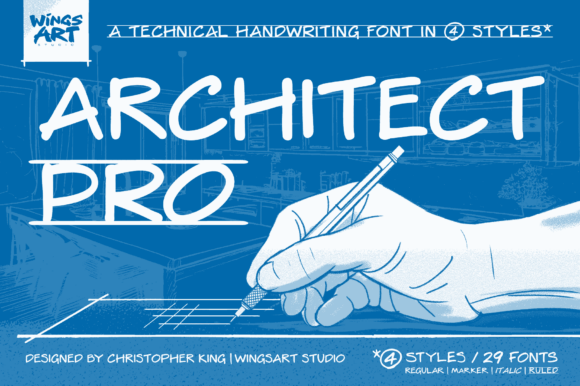
Architect Pro: The Standard for Technical Lettering
In the realm of professional design, clarity is not merely an aesthetic preference; it is a functional necessity. This principle lies at the heart of Architect Pro, a typeface designed to emulate the precise, legible handwriting that defined architectural drafting for nearly a century. Before digital tools took over the industry, architects and engineers relied on a specific style of lettering to convey complex information on blueprints. Architect Pro captures this tradition, offering a digital solution that balances the authority of technical drawing with the readability required in modern communication.
The evolution of architectural lettering was driven by the harsh realities of construction and engineering. A misread dimension or a confused label could result in costly errors, structural failures, or significant delays. Consequently, draftspeople developed a method of writing that prioritized uniformity and speed. This style, characterized by its block-like structure and consistent slant, became the informal standard of the profession. Today, Architect Pro serves as a bridge between that historical rigor and contemporary design needs, providing a font that feels authentic while remaining versatile for various applications.
The Origins of Architectural Lettering
To understand the value of Architect Pro, one must first appreciate the context from which it emerged. In the early 20th century, the architectural drafting process was entirely manual. Draftsmen worked with ink pens and rulers, creating drawings that would be photographed and reduced to blueprint sizes. At these smaller scales, intricate serifs or overly decorative strokes would blur into illegibility. The solution was a minimalist, sans-serif approach to handwriting.
This unique style of lettering required immense discipline. Every letter had to be constructed with geometric precision, ensuring that even when reduced to a fraction of its original size, the text remained distinct. The goal was to create a visual language that was instantly recognizable to anyone on the construction site, from the lead architect to the laborer pouring concrete. Architect Pro replicates this functionality. It does not attempt to mimic the chaotic nature of casual handwriting but rather the controlled, deliberate strokes of a master draftsman.
The transition from hand-drawn plans to Computer-Aided Design (CAD) initially threatened to erase this craft. Early digital fonts often lacked the subtle variations that gave hand-lettered text its character. However, as the industry matured, there was a renewed appreciation for the human touch within technical documents. Architect Pro addresses this gap by digitizing the aesthetic of traditional lettering without sacrificing the consistency that modern software demands.
Key Characteristics and Design Philosophy
What sets Architect Pro apart from other script or handwritten fonts is its adherence to the principles of technical clarity. Unlike calligraphic fonts that prioritize artistic flair, this typeface is built on a foundation of utility. Its defining characteristics include:
- Uniform Stroke Width: Similar to the lines drawn with a technical pen, the letters maintain a consistent thickness. This ensures that the text holds up well under high-contrast printing conditions and remains readable at small point sizes.
- Geometric Structure: The letters are constructed with a block-style logic. Curves are simplified, and angles are sharp, mimicking the way a draftsman would guide a pen along a ruler or template.
- High Legibility: Every character is designed to be distinct. Ambiguities common in cursive writing, such as confusing an 'a' with an 'o' or a 'u' with a 'v', are eliminated through careful spacing and form.
- Consistent Slant: The font features a moderate rightward slant, a hallmark of rapid, efficient handwriting used in field notes and preliminary sketches.
These elements combine to create a font that feels authoritative yet approachable. When you use Architect Pro, you are invoking a sense of professionalism associated with the building trades and engineering sectors. It suggests that the content has been measured, calculated, and verified. This psychological impact is crucial for professionals who need to establish trust with their audience immediately.
Practical Applications in Modern Workflows
While the roots of this style are deeply embedded in the history of architecture, its application today extends far beyond blueprints. Professionals across various industries find practical value in Architect Pro for several reasons.
Designers and Architects: For those still working with hybrid workflows or presenting concepts that require a "sketchy" feel, this font is invaluable. It allows for annotations on digital renderings that look like they were added by hand, adding a layer of authenticity to presentations. It bridges the gap between the roughness of a concept sketch and the polish of a final deliverable.
Educators and Publishers: In educational materials related to STEM fields, using a font that resembles technical notation can help students connect with the material. It reinforces the idea that the subject matter is grounded in real-world practice. Similarly, publishers of trade manuals or instructional guides may use Architect Pro for sidebars, warnings, or diagrams to differentiate critical information from body text.
Marketers and Branding: Brands in the construction, renovation, or industrial sectors often seek a visual identity that conveys reliability. Using Architect Pro in logos, headers, or marketing collateral can signal expertise and attention to detail. It avoids the generic feel of standard sans-serifs while maintaining a clean, corporate aesthetic.
Evaluating Performance and Usability
When assessing a typeface like Architect Pro, usability is just as important as aesthetics. In real-world scenarios, a font must perform reliably across different mediums and devices. From a technical standpoint, this font excels in rendering consistency. Whether displayed on a high-resolution monitor, printed on a large-format poster, or viewed on a mobile device, the characters retain their integrity.
One of the primary strengths of Architect Pro is its flexibility regarding size. Many handwritten fonts become unreadable when scaled down, with loops and tails merging into a mess. Because this typeface is modeled after the constraints of blueprint lettering, it maintains clarity even at very small sizes. This makes it suitable for detailed diagrams, footnotes, and technical specifications where space is limited.
However, users should be mindful of its limitations. While excellent for headings, captions, and short bursts of text, Architect Pro is not ideal for long-form body copy. The distinctive style can become fatiguing to read over multiple paragraphs. It is best deployed as an accent font—used to draw attention to specific elements rather than to carry the weight of an entire document. Pairing it with a neutral sans-serif or serif font for body text creates a balanced hierarchy that enhances readability.
Reliability and Long-Term Value
In the fast-paced world of digital design, trends come and go quickly. Fonts that rely on fleeting stylistic fads often lose their appeal within a few years. Architect Pro, however, draws from a tradition that has stood the test of time. The underlying principles of architectural lettering—clarity, precision, and efficiency—are timeless. This gives the font a longevity that purely decorative scripts lack.
For freelancers and small business owners, investing in resources that offer long-term value is essential. A font that remains relevant regardless of shifting design trends reduces the need for frequent rebranding or asset updates. Furthermore, the professional association of the style means it will continue to resonate with audiences seeking expertise and authority. It is a tool that communicates competence, a quality that never goes out of style.
Who Benefits Most from This Typeface?
Architect Pro is particularly well-suited for individuals and organizations that operate at the intersection of creativity and technical precision. If your work involves conveying complex information clearly, this font can enhance your presentation. It is an excellent choice for:
- Architects and interior designers presenting conceptual plans.
- Engineers creating technical documentation or safety manuals.
- Contractors and builders developing proposals and project reports.
- Educators teaching design, drafting, or engineering principles.
- Creatives looking to add a "technical" or "industrial" vibe to branding projects.
Conversely, if your goal is to evoke whimsy, romance, or extreme informality, this font may not be the right fit. Its inherent seriousness and structural rigidity might clash with softer, more emotional brand narratives. Understanding the tone you wish to set is key to determining whether Architect Pro aligns with your specific project goals.
Final Thoughts on Implementation
The decision to incorporate Architect Pro into your workflow should be based on a clear understanding of its purpose. It is not just a font; it is a nod to a legacy of precision and clarity. By adopting this style, you are signaling to your audience that you value accuracy and professionalism. Whether you are annotating a digital blueprint, designing a brochure for a construction firm, or creating educational content, this typeface offers a reliable way to communicate with authority.
Ultimately, the strength of Architect Pro lies in its ability to merge the past with the present. It honors the meticulous craftsmanship of the pre-digital era while leveraging the convenience of modern typography. For professionals who demand both aesthetic appeal and functional performance, it represents a valuable addition to their design toolkit. Used correctly, it elevates the perception of your work, ensuring that your message is not only seen but understood with absolute clarity.