Welcome Drama: A Practical Evaluation of a Modern Handwriting Typeface
In the crowded landscape of digital typography, finding a typeface that balances artistic flair with functional legibility is often a challenge for designers. Welcome Drama emerges as a distinct option in this space, positioning itself as a modern and fancy handwriting font designed to elevate visual communication. Unlike generic script fonts that can appear dated or overly decorative, Welcome Drama offers a contemporary aesthetic suited for high-impact applications such as posters, logos, magazines, and book covers. For professionals and enthusiasts alike, understanding where this specific typeface fits within a broader design strategy is essential before integrating it into a project.
The decision to adopt a new font is rarely just about aesthetics; it involves evaluating versatility, readability, and the emotional tone the typeface conveys. This analysis explores the characteristics of Welcome Drama, compares it against other typographic approaches, and outlines the specific scenarios where it delivers value versus when alternative choices might be more appropriate.
Defining the Character and Distinctiveness of Welcome Drama
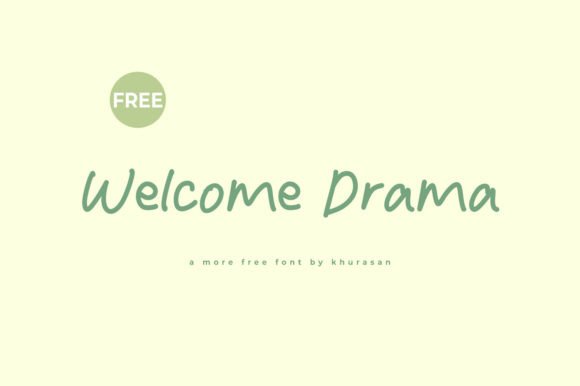
Welcome Drama is categorized as a modern handwriting font, yet it diverges from traditional cursive scripts by incorporating structural elements that enhance its stability and visual weight. The "fancy" descriptor often associated with this font refers not to excessive ornamentation, but to a refined elegance in stroke variation and letterform construction. It mimics the fluidity of human handwriting while maintaining the consistency required for professional typesetting.
What makes Welcome Drama distinct is its ability to function as both a display font and a semi-body text option in specific contexts. Many handwriting fonts struggle when scaled down or used in longer paragraphs due to irregular spacing and complex ligatures. Welcome Drama addresses this by offering a balanced x-height and clear character differentiation, allowing it to remain legible even at moderate sizes. This quality makes it particularly effective for headlines on banners or magazine covers where the text must command attention without sacrificing clarity.
Furthermore, the font's modern interpretation allows it to pair well with minimalist sans-serif typefaces, creating a contrast that feels current rather than retro. This adaptability is crucial for designers working across various media, from digital social media graphics to print materials like book covers and event invitations.
Comparing Welcome Drama to Traditional Script Alternatives
When evaluating Welcome Drama, it is helpful to compare it against the broader category of script and handwriting fonts. Traditional calligraphy-inspired fonts often prioritize historical accuracy and extreme flourishes. While these are beautiful, they can limit usage to very short phrases or purely decorative elements. In contrast, Welcome Drama adopts a more pragmatic approach to the script style.
- Legibility vs. Ornamentation: Older script styles often sacrifice readability for style. Welcome Drama maintains a higher degree of legibility, making it a safer choice for projects where the message needs to be read quickly, such as on a promotional poster or a storefront sign.
- Modern Aesthetic: Many alternatives carry a vintage or Victorian feel. If a project requires a clean, contemporary look, Welcome Drama provides a fresher alternative that aligns better with modern branding trends.
- Versatility: While some handwriting fonts are rigid in their application, Welcome Drama is designed to match an incredibly large set of projects. This flexibility reduces the need for designers to maintain a vast library of niche fonts for different tasks.
However, it is important to acknowledge tradeoffs. If a client specifically seeks a highly ornate, old-world manuscript look for a historical novel cover or a formal wedding invitation, Welcome Drama may lack the specific period details found in specialized calligraphic fonts. Its strength lies in its modern execution, which means it may not fit every stylistic requirement equally well.
Evaluating Strengths and Limitations in Real-World Applications
To make an informed decision, one must weigh the strengths of Welcome Drama against its limitations in practical scenarios. The font excels in environments that require a touch of personality without overwhelming the viewer. Its "drama" comes from the confident stroke weight and the dynamic flow of the letters, which can make a simple logo feel bespoke and memorable.
Best-Fit Situations:
Welcome Drama is an ideal choice for creative industries where visual impact is paramount. For example, in magazine design, using Welcome Drama for section headers can break up dense blocks of text and guide the reader's eye naturally. Similarly, for book covers in genres like romance, lifestyle, or modern fiction, the font adds an emotional layer that serif or sans-serif fonts cannot achieve alone. Banners and event posters also benefit from its scale-friendly nature, ensuring that key information stands out from a distance.
Potential Limitations:
Despite its versatility, Welcome Drama is not a universal solution. It should generally be avoided for body text in long-form documents, technical manuals, or corporate reports where strict neutrality and maximum readability are required. The inherent "handwritten" quality introduces a level of informality that may clash with serious, data-driven content. Additionally, while the font is described as easy to match with many projects, it still requires careful pairing. Using it alongside another display font can create visual clutter, diminishing the effectiveness of both.
Decision Factors: When to Choose Welcome Drama and When to Look Elsewhere
Selecting the right typeface is a strategic decision that impacts brand perception and user engagement. Designers should consider Welcome Drama when the project goal is to evoke creativity, warmth, or sophistication. If the objective is to create lovely designs that stand out in a saturated market, the unique character of this font can provide a competitive edge.
Conversely, there are clear indicators when an alternative resource is necessary. If the project demands extreme scalability for small print sizes, such as fine print on packaging or legal disclaimers, a standard sans-serif or serif font would be a more prudent choice. Similarly, if the target audience expects a strictly corporate or industrial aesthetic, the playful nature of a handwriting font like Welcome Drama might undermine the intended message.
Another critical factor is the available character set and language support. While Welcome Drama is designed for a wide range of uses, users should verify that it supports all the necessary characters for their specific project, especially if working with multilingual content. Some specialized fonts offer extensive OpenType features, including alternate glyphs and ligatures, which may be superior for highly customized typographic layouts.
Integrating Welcome Drama into a Broader Design Strategy
For those who decide that Welcome Drama is the right fit, successful integration relies on understanding how to balance it within a layout. The font works best when used sparingly to highlight key elements rather than dominating the entire composition. Pairing it with a neutral, geometric sans-serif can create a harmonious contrast that enhances readability while retaining the artistic flair of the script.
Designers should also experiment with color and texture. Because Welcome Drama has a strong visual presence, it can handle bold colors and gradients effectively, making it suitable for vibrant marketing materials. However, in monochrome or high-contrast black-and-white designs, the font's line weight becomes the primary focus, requiring careful attention to kerning and spacing to ensure the letters do not collide visually.
Ultimately, the value of Welcome Drama lies in its ability to bridge the gap between personal expression and professional design. It offers a tool for creators to add a distinctive voice to their work without compromising on quality. By understanding its specific strengths, comparing it thoughtfully against other options, and recognizing its limitations, designers can leverage this font to create impactful, memorable visuals that resonate with their intended audience.